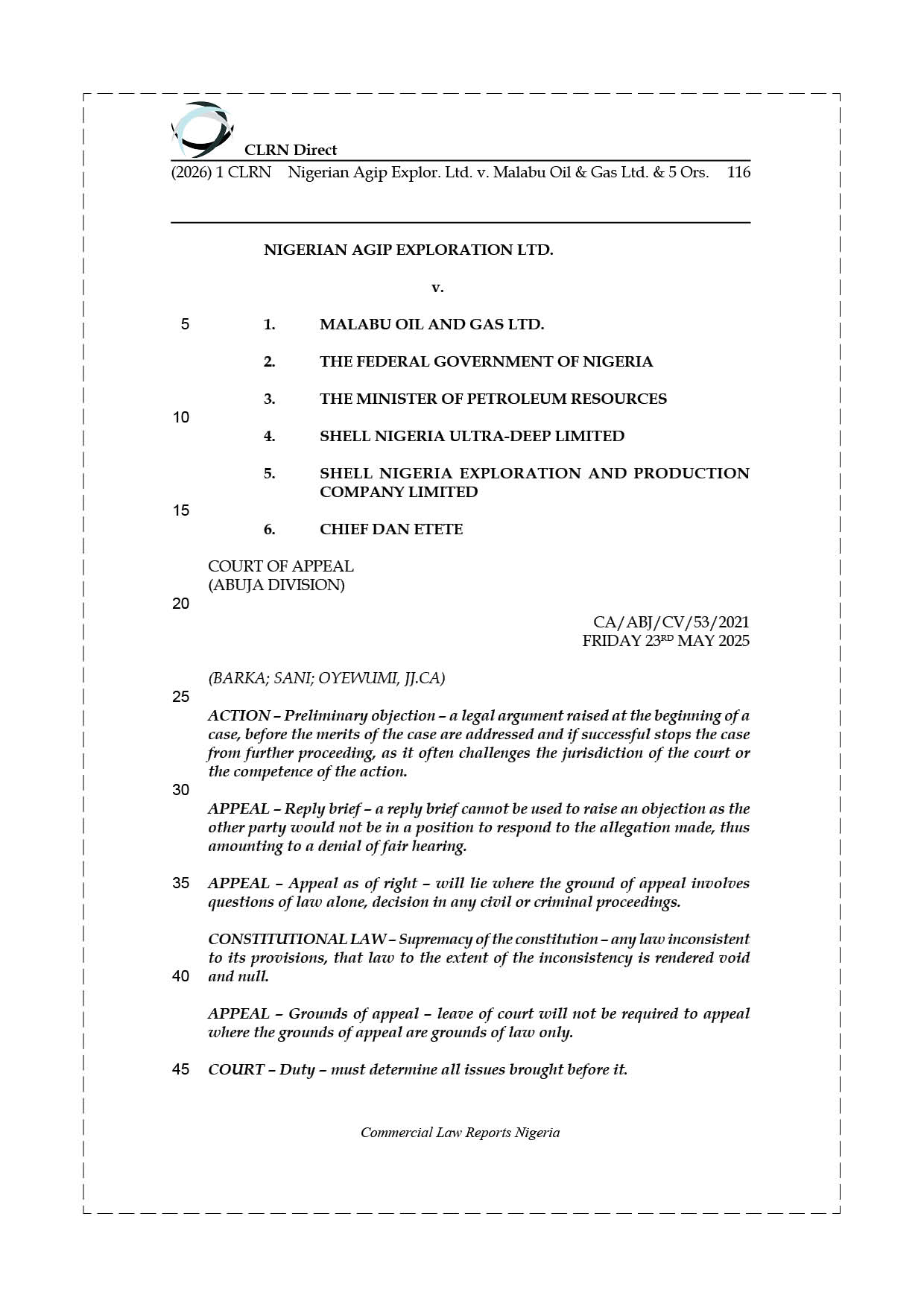
NIGERIAN AGIP EXPLOR. LTD. v. MALABU OIL & GAS LTD. & 5 ORS.
₦1,000
In Stock
Facts:
The 1st respondent, the plaintiff at the trial court, was initially allocated oil block OPL 245 by a letter dated 29th April 1998, but by a letter dated 2nd July 2001, the allocation was revoked by the Federal Government of Nigeria (the 2nd and 3rd respondents). So, the 1st respondent sued the Federal Government of Nigeria. The suit was amicably settled out of court. And on the basis of the settlement agreement dated 30th November 2006, OPL 245 was returned to the 1st respondent by letter dated 2nd July 2010. Later, on the execution of a “Block 245 Resolution Agreement “dated 29 April 2011 and acting under section 2 of the Petroleum Act, Cap. P10, Laws of the Federation of Nigeria 2004, the Federal Government of Nigeria (the 2nd and 3rd respondents) by a letter of award dated 11 May 2011, allocated OPL 245 to the 5th respondent and the appellant.
Aggrieved with the foregoing, the 1st respondent filed a suit before the Federal High Court by a General Form of Complaint dated 17th March 2017. The 1st respondent pleaded that despite acknowledging the validity and subsistence of the 1st respondent’s licence to OPL 245 in the recitals to the “Block 245 Resolution Agreement”, the 3rd respondent surreptitiously granted the license to OPL 245 to the appellant and the 5th respondent on 11th May 2011, thus breaching their earlier contract over OPL 245 with the 1st respondent and creating conflicts over the rights to OPL 245.The 1st respondent also averred it was not a party to the “Block 245Resolution Agreement” and that the agreement was kept away from its knowledge until it became aware and filed its suit.
The appellant filed a notice of preliminary objection to the suit. It challenged the competence of the action, and sought the dismissal or striking out of the suit for lack of jurisdiction on the grounds that the 1st respondent’s suit was statute barred under the Public Officers Protection Act having been commenced more than five years after the purported cause of action arose; that is, the allocation of OPL245 to the appellant and 5th respondent on 11th May 2011. The 1st respondent’s suit was incurably defective and an abuse of court process, being an action challenging the exercise of statutory powers by a Public Officer (3rd respondent) which ought to have been commenced by way of application for judicial review under Order 34 of the Federal High Court (Civil Procedure) Rules 2009, and not by writ of summons. The 1st respondent’s suit was incurably defective and an abuse of court process, having been commenced on behalf of the 1st respondent by persons who are neither directors nor shareholders of the 1st respondent.
The trial court heard the objection and delivered its ruling. It found that all grounds of the preliminary objection failed, and struck out the objection. Dissatisfied with the trial court’s ruling, the appellant appealed to the Court of Appeal on seven grounds of appeal. The grounds of appeal raised questions whether the suit at the trial court was statute-barred under section 2(a) of the Public Officers Protection Act; whether the appellant’s right to fair hearing was violated in the hearing of the case before the trial court; whether the action was an abuse of the court process having been commenced by writ of summons and or by being commenced on behalf of the 1st respondent by persons who were neither its directors or shareholders; and whether the action did not constitute multiplicity of actions.
The 1st respondent, on its part, raised a preliminary objection to the appeal on two grounds. The first was that the appeal was incompetent in law because though an interlocutory appeal, it was filed without leave of either the trial court or the Court of Appeal first sought and obtained as statutorily required by section 14(1) of the Court of Appeal Act. The second was that the appellant’s seven grounds of appeal were incompetent because they are grounds of mixed law and facts raised without leave of the trial court or the Court of Appeal first sought and obtained as required by section 242(1) of the Constitution of the Federal Republic of Nigeria 1999 (as amended).